History
Inaugurated in 1905 in a refined building in Liberty style (Italy’s art nouveau) at the heart of Via XX Settembre, the Hotel Bristol Palace has been one of the most prestigious landmarks of Genoese hospitality for over a century.
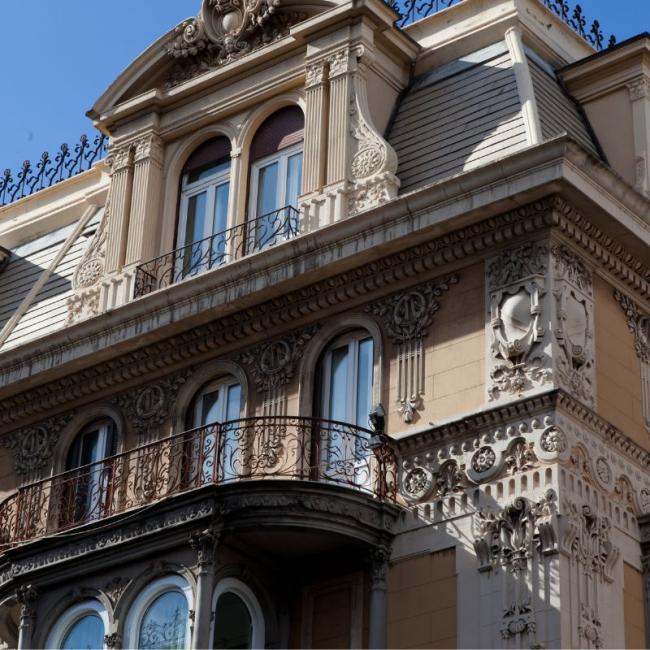
the palazzo
In the days of the Belle Époque, the Hotel Bristol Palace was one of the main salons of Genoese high society, the setting for parties, banquets and events which animated the cultural life of the city.
It was already a social landmark in the first decades of the 20th century, and attentive restoration work has restored it to its prior splendour, retaining all the original charm.
Located in the heart of Genoa, on Via XX Settembre — the elegant artery built between the late 19th and early 20th century — the hotel is a short walk from the Palazzo Ducale, Piazza De Ferrari, Teatro Carlo Felice theatre, the main city museums, and Palazzi dei Rolli, a UNESCO world heritage site.
Since its inauguration it has been considered one of the most prestigious hotels in the city, chosen by Genoese society as a refined location for exclusive events and meet-ups.
Over the years, its prestige has attracted numerous leading figures in culture, politics and international showbusiness. These include Edmondo De Amicis – who, on leaving the hotel, wrote: “I left the Bristol under the illusion that I’d been a great gentleman for five days” – Gabriele D’Annunzio, Luigi Pirandello, Alfred Hitchcock, Vittorio De Sica, Alberto Sordi, the Infante of Spain, Carlo Azeglio Ciampi, Yitzhak Rabin, Shimon Peres, Rita Levi-Montalcini, Rudolf Nureyev, Carla Fracci, Prince Albert of Monaco, and Emanuele Filiberto of Savoy, Prince of Venice.
Its fame did not protect it from historic events, however: during the Second World War, the German command installed its headquarters there, creating a secret tunnel to the Port of Genoa; at the end of the conflict, the National Liberation Committee for Northern Italy established its own headquarters there.
Now splendidly restored, the Hotel Bristol Palace retains original structures and precious furnishings.
In March 2014, thanks to Duetorrihotels Group's commitment, major renovation works fully highlighted the building's Liberty and Art Deco elegance, bringing back to light objects and furnishings from the 19th and early 20th century.
Today, the spaces recount this heritage through distinctive elements such as the sumptuous Napoleon III suites, the marble of the banqueting rooms and event spaces, and the parquet of the convention rooms and the Giotto restaurant, where the plaster and frescoes help define an extremely refined atmosphere. The Sala Michelangelo, the old reading room, retains the large mirror, appliqués and the central chandelier, testament to the luxury characteristic of period hospitality.
The Hotel Bristol Palace is a member of Locali Storici d’Italia, a cultural association with the Italian Minister of Culture as patron, which protects and develops locations symbolic of national memory and tradition.
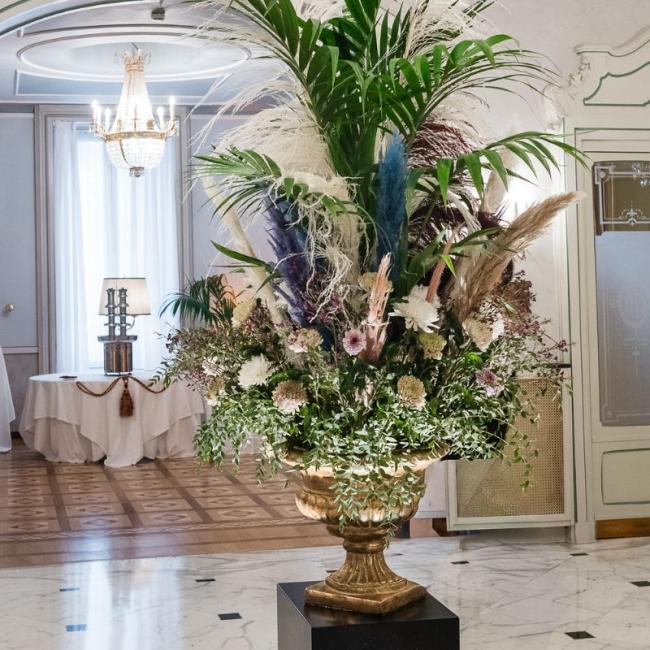
In 2025 the hotel celebrated the 120th anniversary of its opening with an event which involved institutions, guests and key players from the city’s cultural life. This anniversary reaffirmed the deep bonds between the hotel and the city, of which it is one of the most recognisable expressions.
Today, the Hotel Bristol Palace continues to represent a location where history, art and hospitality come together harmoniously, guarding the memory of the city and offering an authentic experience in the heart of Genoa.
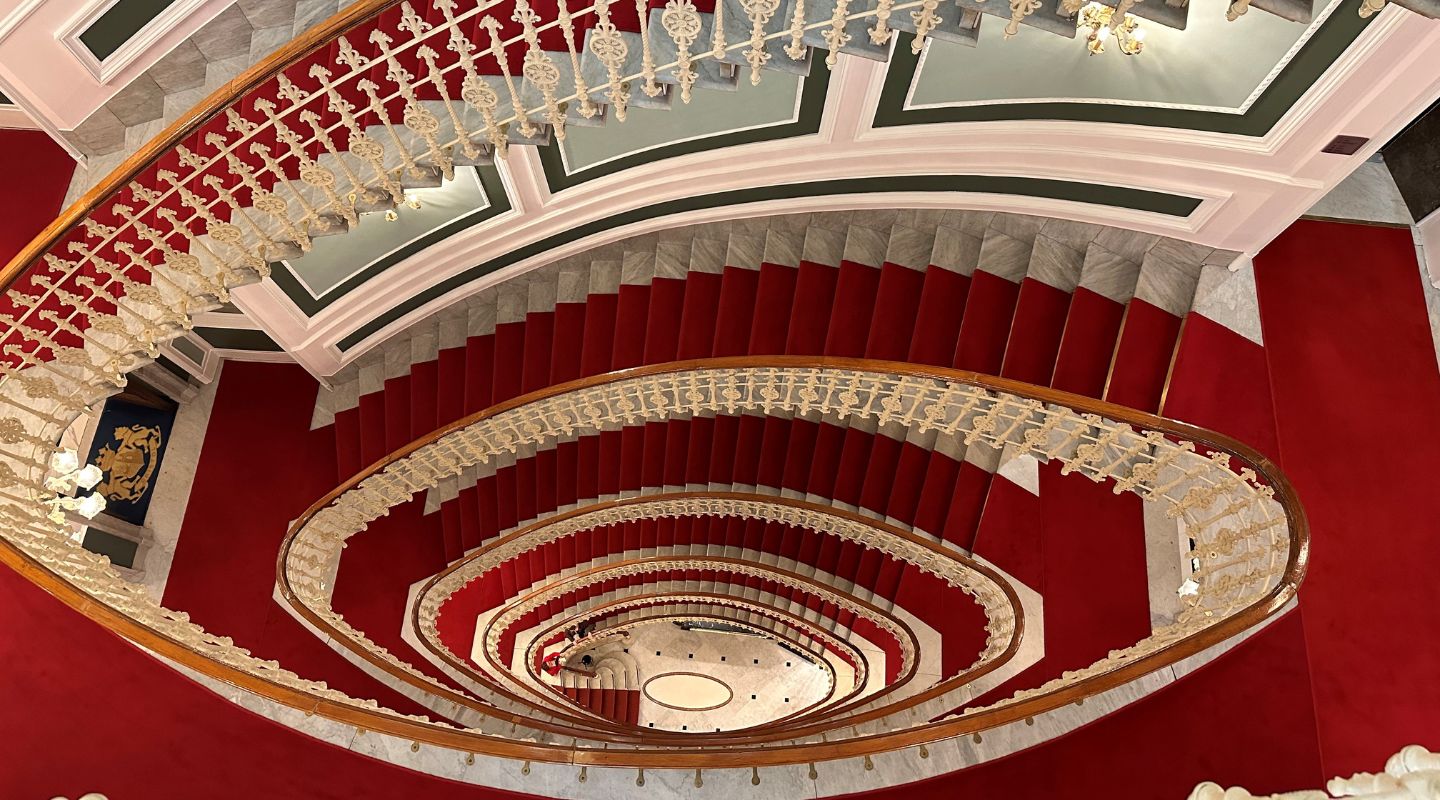
THE LIBERTY STAIRCASE
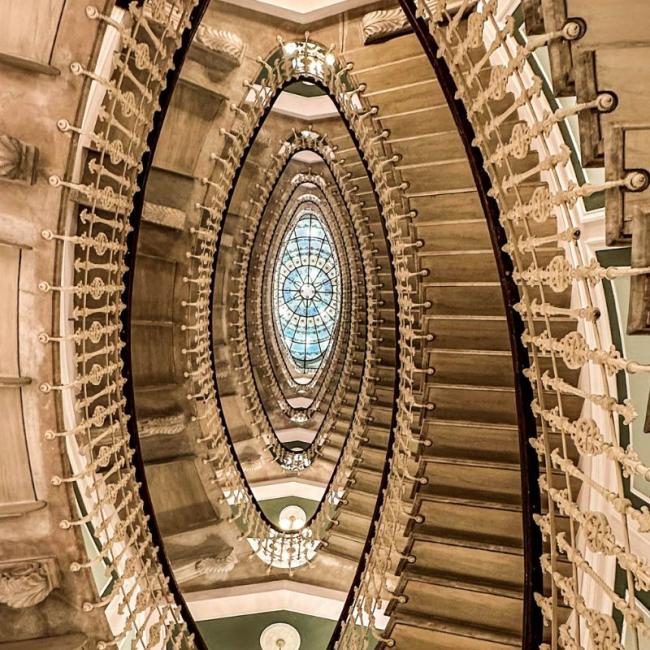
Among the Hotel Bristol Palace's most distinctive architectural elements is the imposing white marble elliptical staircase, an icon of Liberty (Italian art nouveau) style.
The structure stands as an extremely elegant suspended spiral, offering views of high visual impact both from the top and the bottom.
A fascinating theory is linked to this staircase: Alfred Hitchcock, a guest at the hotel on multiple occasions, very possibly found perhaps the most famous visual reference for perhaps his greatest film, Vertigo, here.
The director indeed stayed in Genoa in 1925, while shooting his first film, The Pleasure Garden, marking the beginning of one of cinema's most legendary careers. Still today the Liberty staircase represents the spectacular focal point of the hotel, an identifying element which defines its architectural character and charm.
Many years later, interviewed by François Truffaut for the celebrated biography Le cinéma selon Hitchcock, Alfred Hitchcock remembered his stay in Genoa in a lively and ironic manner, recounting how he was shooting with an improvised crew at the port, often suffering all kinds of mishaps.
Despite these difficulties, that first film marked his “box-office baptism”: the Daily Express called him “a young man with a master mind”. He was now on the road to success, and his name would become indelibly linked in the years to come with the history of international cinema.
Still today the Liberty staircase represents the spectacular heart of the Hotel Bristol Palace, a distinctive element which defines its architectural character and charm.
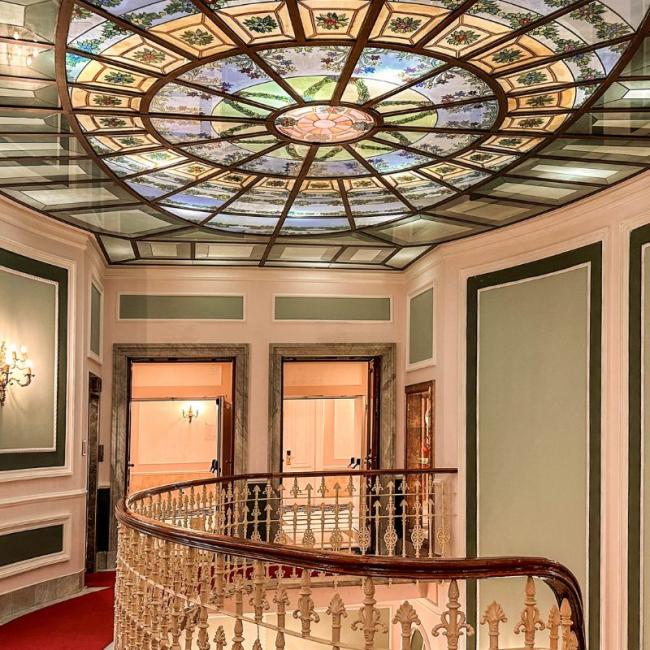
In 2012, the hotel began a continuous programme aiming to combine the structure's historic heritage with modern-day comforts and technologies. The works have gradually taken in corridors, rooms and bathrooms, exalting the Liberty elegance and Art Deco furnishings characteristic of this palazzo in the heart of Genoa.
Preferred Hotel
This commitment to ever-higher standards led to the Hotel Bristol Palace joining the Preferred Hotels & Resorts L.V.X. collection in 2016, an international network consisting of luxury destinations in over 85 countries.
In addition to its privileged position, a short walk from the city's most symbolic sites, the hotel stands out with its famous elliptical white marble staircase, its dining options enhanced by the terrace, and for its meeting and event spaces, able to host up to 250 people.
Together, these elements confirm the Bristol Palace as a benchmark for high-end Genoese hospitality.